


Living In Spain:10 Dos and Don’ts

Updated: Jul 11
Letter From Oviedo
July 9, 2026
My Personal Dos and Don’ts for Living In Spain**
In the heart of Oviedo, Spain, I learned some "Do’s and Don’ts" quickly, others more slowly. Whichever the case, consider this a friendly guide that will be useful when you get here.
1. DO use the pedestrian crossings.
DON’T take the chance of crossing the street elsewhere.Spanish drivers are almost painfully respectful of pedestrians as long as the pedestrians are in the sacred zone of zebra markings. Step outside of that, you will incur the wrath of a driver in a car that seemingly appeared out of nowhere and is now bearing down on you with horn blaring. Whether you get across safely is indeterminate.
Crossing the street against the light while on a zebra crossing is acceptable, but even the locals check once, twice, and three times to ensure the coast is clear.

2. (This is possibly the most important Do's and Don'ts Living in Spain.)
DO say hello when entering a small shop or an occupied elevator.
DON’T glide in silently like an undercover agent.
A “buenos dias,” "buenas," or “hola” does nicely, with a smile even better. Otherwise you will be taken as being plainly rude.
3. DO adjust your stomach to Spanish time.
DON’T show up hungry for dinner at 6 PM.
Soon after I got to Oviedo, I went to an Italian restaurant around 6 PM. I was surprised to find it empty and commented on it to the owner. He laughed and pointed to his watch. “That’s because it’s too early.”
Also know that for some parts of the day, say, from 1-5 PM, a restaurant kitchen may be closed (I guess while the chef is taking their siesta), although you can still get a drink at the bar. I still keep my dinner time 7-8 PM as it was in the US. I’m not with the eating-at-midnight thing.
4. Speaking of restaurants,
DO enjoy the art of slowing down.
DON’T expect your waiter to sprint over with the bill the minute you rest your fork.
In Spain, leaving you alone after a meal is served is considered polite. Americans call it “Where did my waiter go?” And the waiter is definitely not going to come back to your table while you’re eating to ask, “Everything ok?”, to which you feel obligated to answer something like, "Wonderful!"
Also, if you go into a restaurant that has an order counter, you pay for the meal at the counter, but you order the meal from your seat. Stay calm, relax, cool your jets, and don’t panic. A waiter will arrive. Trust me, they have noticed you enter the establishment.
5. DO appreciate the Spanish art of looking arreglado/a (nicely put together or arranged)
On the other hand, DON’T believe everyone is walking around like a fashion model.
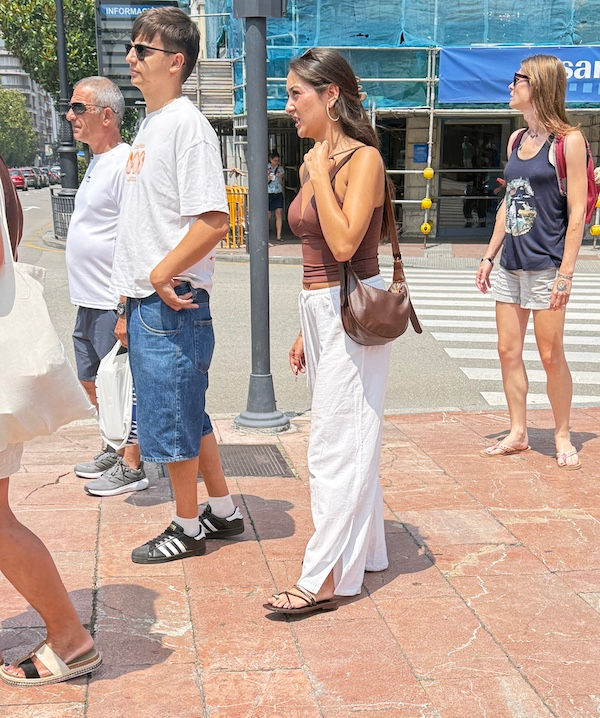
Okay, it is said that Spaniards (and other Europeans) dress better than Americans. However, flip-flops, sandals, hoodies, sneakers, sweatpants and sloppy dressing do exist. On the other hand, don’t be surprised when an 85-year-old señora buying bread looks more elegant than you did at your last formal event. Members of the large elderly population in Oviedo are almost invariably well-dressed and freshly-coiffed, even to go for a coffee. It would be bad form otherwise.
6. DO understand Spanish quiet zones.
DON’T assume “inside voice” means the same thing everywhere.The second and third floors of the Oviedo library may be silent enough to hear a page turn, but the lobby sometimes sounds like someone moved a family reunion indoors, and signs warning you to have your mobile on silent is observed more in theory than in practice.
Once in a bus that is part of Oviedo’s superb public transportation system, I thought I was at an outdoor market in Accra, what with people on the phone and animated discussions between bus-riders. It’s all totally fine, though. Talk as loud and long as you want; no one will shush you.

7. DO learn the rhythm of Spanish shopping hours.
DON’T assume your emergency is the shopkeeper’s emergency.
Need something urgently at 2:30 PM? Spain may gently remind you that someone else’s lunch is also important. It used to drive me crazy, now I just shrug and put it off till later in the day or tomorrow. One to 5 PM is the danger zone. On the other hand, a lot of businesses stay open quite late.
8. DO embrace walking as part of daily life.
DON’T expect every small errand to require transportation.
In Oviedo and other cities in Spain, “it’s nearby” may mean a lovely 25-minute walk uphill, downhill, through three plazas, and past four cafés. Somehow, it still counts. Walking in Oviedo has proven to be therapeutic and relaxing for me. Twenty-five minutes on foot is really nothing at all. I would consider a really long walk to be, say, one hour or more, and I’ve done that too. Because Oviedo is hilly, you get a good glutes workout.
9. DO respect the sobremesa (“over table”).
DON’T jump up after your last bite like the building is on fire.In Spain, finishing the food does not mean finishing the meal. The conversation after eating is practically another course. This is a well-worn tradition. You simply can’t abruptly get up and leave. That’s totally rude.

10. DO adapt to “no pasa nada.”
DON’T treat every inconvenience like a five-alarm emergency.
A small delay? A changed plan? Something doesn’t work exactly as expected? Spain often responds with: “No pasa nada,” (lit. "nothing happens;” "it’s okay.") And after a while, your blood pressure may agree.
A Bonus Living In Spain Dos and Dont's:
DO learn Spanish.
DON’T panic when real Spanish doesn't quite match your language app.
Your app may teach you perfect sentences spoken at a moderate speed of. Then a real person in Asturias says something at 100 mph dropping half the consonants and adding local slang, and you wonder if this is the same language you learned.
Recognize that Castilian Spanish differs often substantially from Latin American, Cuban, or Puerto Rican Spanish, the major variation being the velocity of speech--much faster in Spain!
*All photos by Kwei Quartey unless otherwise noted.
**Observations from Oviedo, Spain. Other cities may vary


Thanks for providing useful information in a simple and readable format. Many readers prefer clear updates when checking daily lottery results. Searching for lotería de hoy can help people find current result information, but it is always best to confirm the numbers through an official lottery website.
This article kept an approachable tone while sharing the thoughts in a readable way, which made the whole read feel lighter. It gave a clean impression without feeling heavy. fix foggy windows
The post stayed readable and thoughtful while the clear layout kept the message simple. It kept things simple as well. historic wedding venues melbourne
I liked how this piece handled the ideas in a readable way, which helped the content feel more complete. It felt useful overall in a simple way.
landscapers melbourne
The simple style made the article feel more complete while keeping the writing pleasant. It felt calm and helpful while keeping things clear. engagement venues melbourne